The question is no longer which fluff, but which mix for which product
For decades, the absorbent hygiene industry has relied predominantly on softwood fluff pulp to manufacture products such as diapers, feminine care products and adult incontinence solutions.
But what if the future of this industry is not about choosing between softwood and hardwood fibers, but about finding the right combination of materials to deliver the best performance for each product?
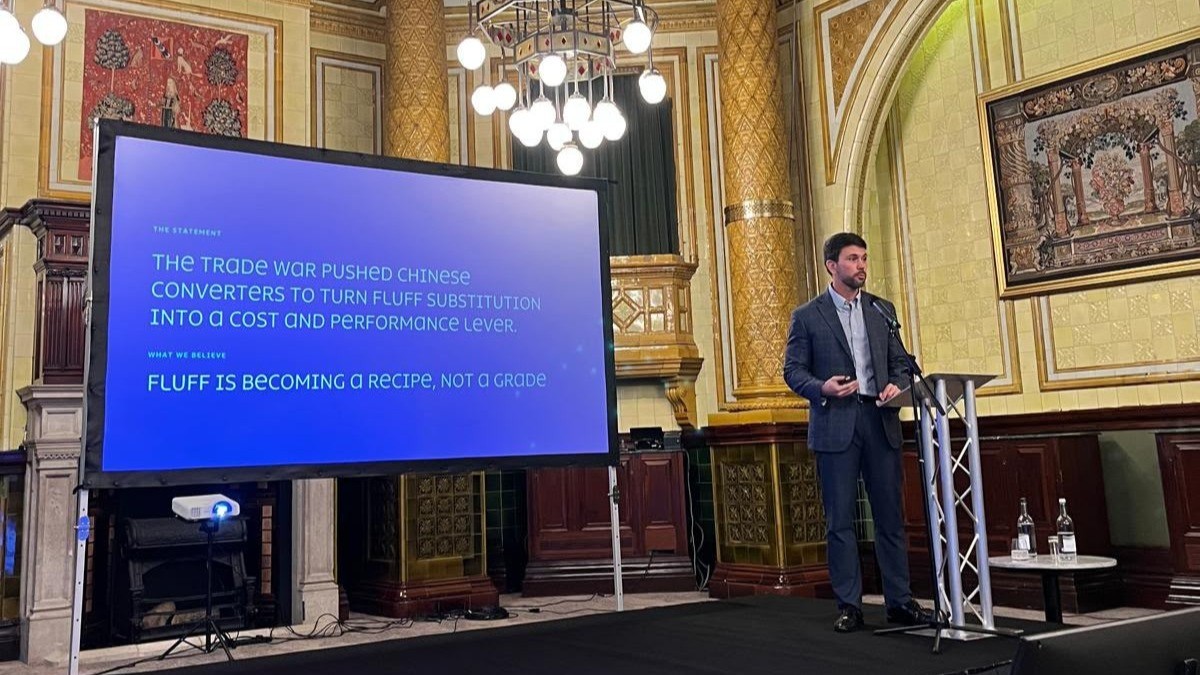
This was the central question I raised during my presentation at the Dissolving & Fluff Pulp Seminar, hosted by Hawkins Wright Ltd as part of London Pulp Week.
I shared my perspectives on how China's rapidly evolving fluff market is reshaping the global absorbent hygiene industry and what this transformation could mean for producers, converters and brand owners worldwide.
My view is that we are witnessing a fundamental shift: fluff is becoming a recipe, not a grade. And China is providing compelling evidence of how quickly this transformation can happen.
China is setting the pace
Over the past two years, trade pressures and the search for greater competitiveness have accelerated changes in China's fluff market.
In the second half of 2024, approximately 80% of the fluff consumed in China was imported. By the first half of 2026, that share had fallen to around 50%.
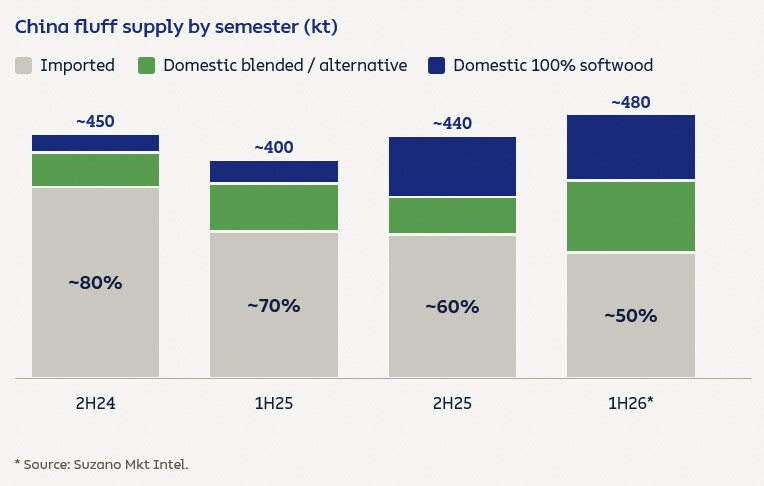
Even more significant is the composition of domestic supply. Approximately half of China's locally supplied fluff now consists of blended or alternative fiber solutions, with hardwood content ranging from 10% to 80%, depending on the grade.
What we are seeing is not simply the emergence of new suppliers. It is a different approach to raw material selection, increasingly driven by the balance between cost and performance.
The implications go well beyond China
In 2024, Chinese manufacturers accounted for 32% of global absorbent hygiene product (AHP) exports. That share reached 36% in 2025 and is estimated to approach 41% in 2026.
In 2025 alone, China added 198,000 tonnes to global AHP exports, while the overall market grew by just 128,000 tonnes, as exports from the rest of the world declined by 70,000 tonnes. In other words, Chinese manufacturers gained market share as exports from the rest of the world declined.
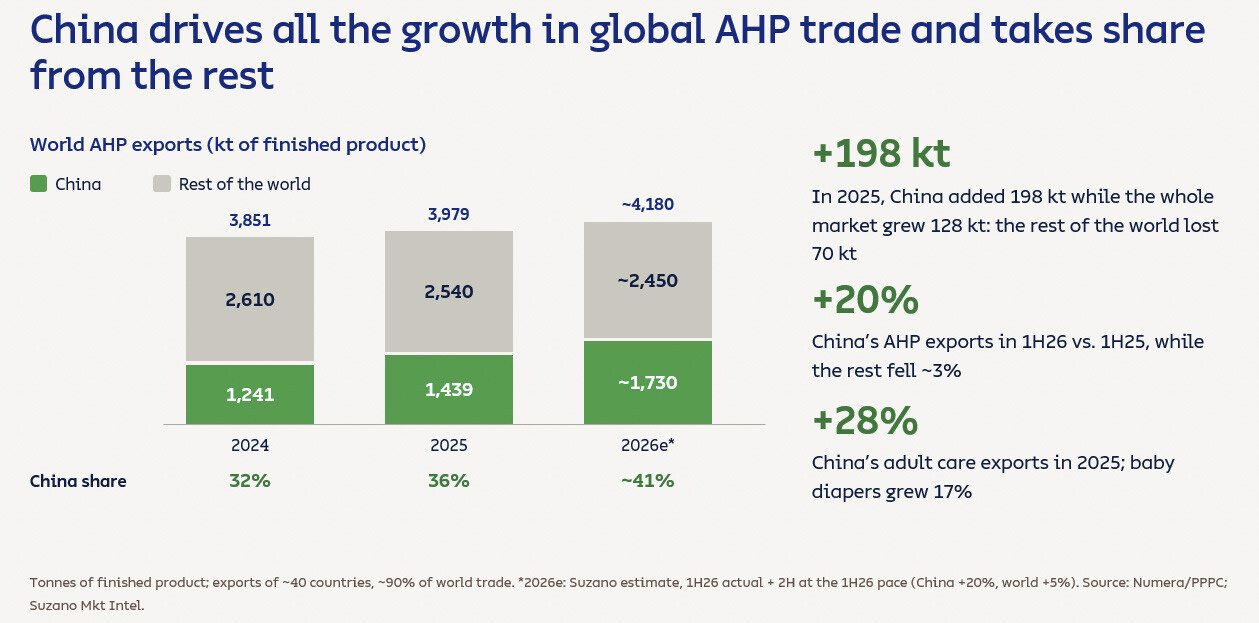
This means that the fiber formulations being adopted in China are already reaching consumers worldwide through finished products, creating new competitive pressures for manufacturers in Europe, the Americas and other markets. What started as a response to local market conditions is becoming a global industry transformation.
Consumers buy performance, not fiber
There is an important principle behind this shift: consumers do not choose what goes inside an absorbent core. They want products that deliver comfort, absorption, dryness and protection at a price they can afford.
This becomes particularly relevant as inflation increases price sensitivity, private-label products gain ground and manufacturers look for ways to improve their cost structures without compromising quality.
At the same time, advances in converting technologies are allowing manufacturers to work with more flexible absorbent core designs and different combinations of materials.
The traditional approach of specifying a particular type of fluff pulp is gradually giving way to a more fundamental question: what does the final product need to deliver? This is where hardwood fibers, including eucalyptus fluff, can play an increasingly important role.
The potential of eucalyptus fluff
At Suzano, our experience developing and expanding Eucafluff, the world's first eucalyptus fluff pulp, has reinforced the importance of looking beyond the properties of individual fibers.
Eucalyptus fibers are significantly shorter and finer than conventional southern pine fibers. These characteristics create opportunities to develop thinner, softer and denser absorbent cores, with improved liquid distribution and retention.
In five customer trials involving different absorbent hygiene applications, formulations containing between 50% and 100% eucalyptus fluff demonstrated improvements of up to 50% in rewet performance, 28% in liquid distribution and 20% in liquid retention, compared with the respective reference products.
Of course, there are trade-offs. Initial absorption can be slower, and the right formulation depends on the application, the manufacturing equipment and the performance requirements.
This is precisely the point. The goal is not to replace one fiber with another in every application. It is to understand how different fibers and technologies can work together to deliver the best possible result. And this requires expertise that goes beyond pulp production.
Through our application engineering capabilities, we work alongside customers to evaluate their production processes, adapt formulations and optimize absorbent core designs.
Developing a new raw material is only the beginning. Turning it into a competitive industrial solution requires collaboration, technical knowledge and, often, a willingness to challenge practices that have been established for decades.
From technical potential to market opportunity
For many years, limited production capacity was one of the barriers to broader eucalyptus fluff adoption. This scenario began to change in 2025, when approximately 465,000 tonnes of additional annual eucalyptus fluff capacity came online globally, including new capacity at Suzano's Limeira mill in Brazil.
With supply constraints easing, other factors become increasingly important, such as machine compatibility, qualification time, product design and established industry specifications. These barriers are not insignificant, but they are becoming easier to overcome as technologies evolve and manufacturers gain experience with alternative formulations.
From a technical perspective, we estimate that hardwood fluff could potentially address approximately 2.2 million tonnes of global fluff demand by 2032, representing close to 30% of the projected market. This is not a sales forecast. It is an estimate of the potential applications that could technically accommodate hardwood fibers, depending on product requirements and manufacturing capabilities. It also illustrates how much room there may be for the industry to explore new solutions.
What this means for the global value chain
I believe this transformation has important implications for every participant in the absorbent hygiene value chain.
For traditional softwood fluff producers, it means that long fibers will continue to play an important role, but increasingly as part of formulations that combine different materials.
For converters, it creates an opportunity to rethink absorbent core designs and qualify alternative formulations that can improve competitiveness.
For brand owners and buyers, it suggests a different approach to product specifications, focusing on the performance an absorbent core must deliver rather than prescribing exactly which fibers it must contain.
And for fiber suppliers, it reinforces the importance of moving beyond raw material supply to provide technical expertise, application development and collaborative solutions.
The shift is already underway in China, and its effects are reaching other markets through global trade. The question is how quickly the rest of the industry will adapt.
The future is fit for purpose
I am not suggesting that softwood fluff will disappear. Some applications will continue to require long fibers, and their properties will remain valuable. What is changing is the role each fiber can play within a broader formulation.
As manufacturers gain access to more flexible technologies and a wider range of fiber solutions, the industry has an opportunity to move away from a one-size-fits-all approach toward products designed around specific performance requirements.
At Suzano, we believe this evolution creates significant opportunities for innovation and collaboration across the value chain.
Ultimately, the future of fluff will not be defined by one fiber replacing another, but by our ability to combine different materials, technologies and expertise to deliver greater value.
The question is no longer which fluff, but which mix for which product.
Let's talk about what we can achieve together!